
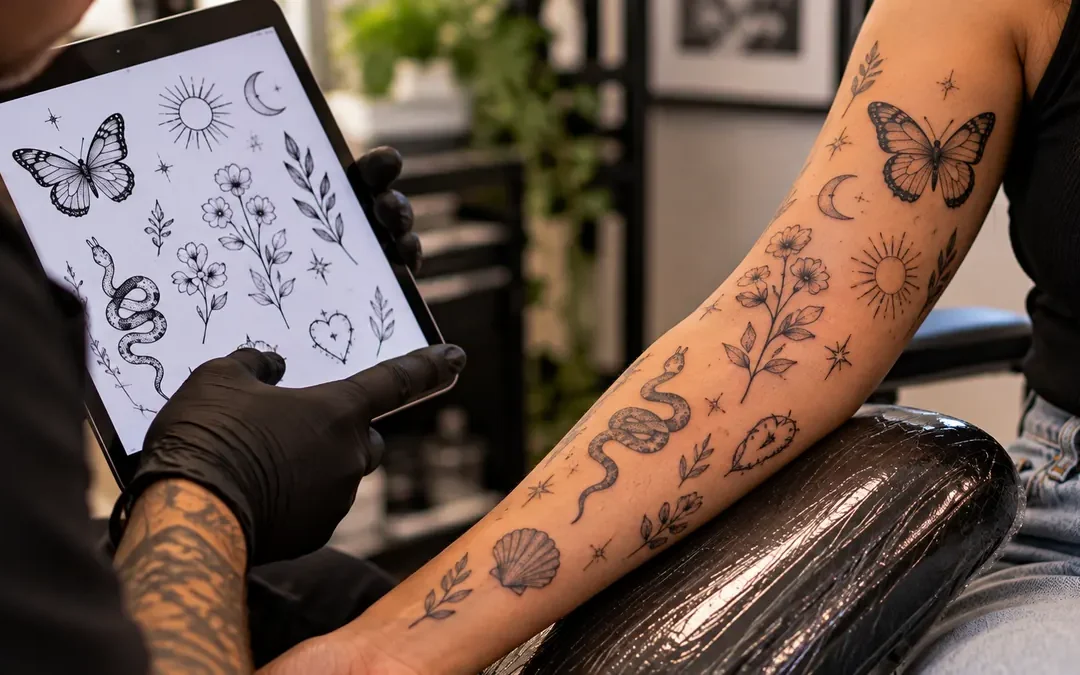
Patchwork tattoos are separate pieces arranged across an area of the body rather than connected into one continuous background. Each tattoo can stand alone, yet spacing, scale and visual weight determine whether the collection feels balanced. The appeal is freedom: you can build it gradually and let different ideas share the same arm or leg.
When we plan patchwork tattoos, Adelaide clients often want room for ideas they have not chosen yet. That means the empty skin matters as much as the first design. In this guide, we explain spacing, style, placement order, fillers and how to keep future options open without making the collection look rigid.
What makes patchwork different from a sleeve?
A traditional sleeve is usually composed as one connected artwork. Patchwork uses individual tattoos with visible skin between them. A patchwork arm may eventually become full, but the pieces remain recognisable as separate designs.
| Patchwork collection | Connected sleeve |
| Separate pieces added over time | Planned as one larger composition |
| Open skin is part of the look | Background often connects major elements |
| Styles may vary within limits | Usually follows one visual direction |
| Flexible booking sequence | Often organised in planned sessions |
| Individual pieces remain obvious | Overall flow leads the eye |
Neither approach is better. Patchwork suits someone who enjoys collecting individual ideas; a planned sleeve suits someone who already wants one continuous theme. Our large-scale tattoo planning guide explores the connected approach in more detail.
Start with an anchor piece or start small?
Both approaches can work. An anchor piece is a larger tattoo that establishes the collection’s scale and visual direction. Starting with smaller pieces creates flexibility, but several small tattoos placed randomly can occupy the best spaces for a future focal design.
Before tattooing the first piece, we ask:
- Do you imagine filling the whole limb eventually?
- Is there a larger subject you already know you want?
- Which areas do you want visible from the front?
- Should the pieces share one style or simply a common weight?
- Are you comfortable leaving larger open areas for now?
- Will existing tattoos become part of the collection?
You do not need a ten-year plan. You do need enough direction to avoid placing a tiny design in the centre of an area that a future anchor could use.
How much space should sit between tattoos?
There is no universal gap. Consistency matters more than an exact measurement. Tight spacing creates a dense sticker-like effect; wider spacing makes each piece quieter and more independent.
Spacing depends on:
- the size of each tattoo
- line weight and darkness
- the body area and its taper
- whether fillers may be added later
- the visual relationship between neighbouring shapes
- how the collection looks from more than one angle
We often mock up more than one position with a stencil. A gap that seems large close up may feel balanced when the whole arm is viewed in a mirror.
Can patchwork tattoos mix styles?
Yes, but cohesion needs another source. If the drawing styles differ, a shared palette, line weight, subject family or scale can hold the collection together.
Ways to create cohesion include:
- using black and grey across all pieces
- keeping outlines within a similar weight
- repeating a small accent colour
- choosing related subjects, such as plants, objects or animals
- maintaining a consistent range of sizes
- repeating shapes, stars or small motifs
- leaving a similar amount of open skin
Mixing delicate fine line, dense realism and bold traditional work on one small area can make the visual weight uneven. It can still be done, but the placement needs more thought than simply filling the next empty gap.
Our colour tattoo guide and black and grey guide can help you decide whether the palette itself should be the connecting thread.
How do we place the first few pieces?
We look at the limb as a whole, even if today’s appointment is for one small tattoo. The front, outer side, inner side and back do not carry equal visual importance for every client.
A practical sequence is:
- identify areas reserved for larger future work
- place the current design where its shape suits the anatomy
- view the stencil from the front, side and back
- check the relationship with joints and clothing lines
- imagine at least two plausible neighbouring pieces
- adjust rotation and spacing before tattooing
This does not lock you into future designs. It simply avoids treating the current tattoo as though no other piece will ever sit beside it.
Choosing subjects that work as patches
Patchwork pieces benefit from a clear silhouette. A design should read as its own object without needing a background to explain it.
Popular subject categories include:
- flowers, leaves and small botanical studies
- animals, birds and insects
- tools, objects and food
- symbols, numbers and lettering
- traditional flash-inspired subjects
- small portraits or framed scenes
- stars, flames and ornamental motifs
- abstract shapes
The list is only a starting point. We adapt the subject so it remains readable at the planned scale and does not look like a cropped section of a larger picture.
Should every tattoo face the same way?
Orientation should make sense on the body and within the group. Portraits and figures usually need an intentional upright view. Long objects may follow the limb, while round subjects can sit more independently.
Not every design needs an identical rotation. In fact, forcing all pieces to face one direction can make a wrapping collection feel flat. We aim for a rhythm that works from the views you care about most.
If you are uncertain, we introduce two or three stencil positions and look in a full-length mirror. This is more useful than deciding from a close photograph of an empty arm.
What are fillers, and when should they be added?
Fillers are smaller marks used to occupy irregular gaps after the main pieces are established. Stars, dots, tiny flowers, ornamental marks and abstract shapes are common examples.
They should usually come later. Adding filler too soon can remove useful room and make the collection feel busy before the main pieces are balanced.
Before adding fillers, we check:
- whether another medium-sized tattoo could use the gap
- whether the collection already has enough visual rest
- whether the filler style belongs with the main work
- whether repeated filler will make the pieces feel connected
- whether the client actually wants a denser result
Empty skin is not a problem that must be fixed. It is part of the patchwork structure.
Can existing tattoos become patchwork?
Usually, yes. Existing pieces do not need to match perfectly, but we need to work with their scale, darkness and spacing. A very large or dark tattoo may become an anchor, while smaller new pieces balance the remaining area.
Possible strategies include:
- repeating some of the existing line weight
- using new pieces to balance visual weight on another side
- leaving a deliberate border around older work
- touching up an old piece before building around it
- colour-correcting selected areas where appropriate
- using fillers only after larger gaps are resolved
If an existing tattoo is unwanted, we assess whether a cover-up tattoo or rework makes more sense than building around it.
What if the gaps look awkward later?
Irregular gaps are normal on a curved body. Some become useful homes for custom-shaped designs; others can remain open. The answer is rarely to squeeze in a generic symbol immediately.
We may sketch a long, narrow subject, a curved botanical element or a small ornamental form specifically for the gap. Custom drawing is valuable here because standard flash may not share the available shape.
Take clear photographs of the entire area, not only the gap. The new piece has to balance the full collection.
Planning colour across multiple appointments
Colour can connect patchwork pieces, but exact ink appearance varies with design, skin and healing. We can plan a controlled palette without pretending every healed area will look identical.
A useful approach is to choose:
- one dominant family, such as warm or cool tones
- one repeated accent colour
- a consistent amount of black outline or shading
- some neutral pieces so the collection can breathe
If you are not sure about a full-colour collection, black and grey pieces with occasional colour accents offer another route. Bring examples of the balance you like rather than selecting colours from a screen in isolation.
Healing a growing collection
Every new tattoo needs its own healing period. An older healed piece does not change the aftercare required for fresh work beside it.
Follow the instructions provided by your artist. Avoid picking, soaking and unnecessary sun exposure while the tattoo heals. SA Health provides information about body art and skin penetration practices, while Cancer Council Australia explains UV protection for skin once healing is complete.
Contact us with routine healing questions. If redness spreads, pain or swelling worsens, discharge appears, or you feel unwell, seek medical advice rather than asking an artist to diagnose the problem.
What to bring to a patchwork consultation
Help us see the collection, not only the next image. Bring:
- photographs of the full limb from several angles
- close images of existing tattoos
- references for the next two or three ideas, if known
- examples of the spacing and density you like
- your preferred colour direction
- any areas you want to reserve
- approximate size for the next piece
- notes about whether you want fillers eventually
We will introduce the placement options and explain which one preserves the best future choices.
Build patchwork tattoos in Adelaide one thoughtful piece at a time
Art n Soul has worked with Adelaide clients since 2012 at 230 Prospect Road, Prospect. For patchwork tattoos, Adelaide clients can arrive with one idea or a growing list; we will help place the next piece without pretending it exists alone.
Call us on (08) 8269 6383 or send photographs and references through our tattoo enquiry page. We will talk through spacing, scale and how much room the collection should keep for what comes next.
Frequently asked questions
1. Do patchwork tattoos need one artist?
No. A collection can include work from different artists. Shared planning around scale, colour and spacing can still improve cohesion.
2. Can patchwork become a full sleeve?
Yes. It may remain visibly patchwork or later use fillers and background elements to become more connected.
3. Should I fill the smallest gaps first?
Usually not. Place the main pieces and assess the overall balance before committing every small area.
4. Are patchwork tattoos cheaper than a sleeve?
We do not publish or invent prices. Cost depends on the number, size, complexity and sessions. Call with your actual ideas for current information.
5. Can patchwork include lettering?
Yes. Lettering needs enough size and spacing to remain readable and should be oriented intentionally within the group.