
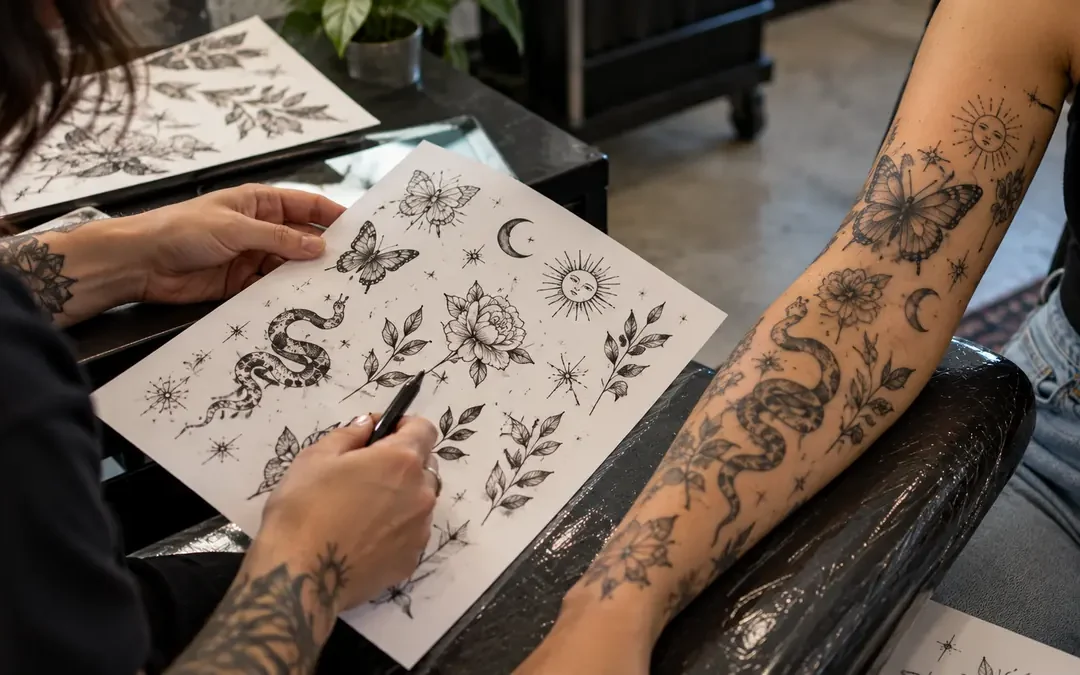
Blackwork uses black ink as the tattoo’s main visual language. It can be solid and graphic, delicate and ornamental, abstract, illustrative or built from repeating patterns. What connects those approaches is not simply “a lot of black”. It is the deliberate balance between filled areas, line, texture and open skin.
When we plan blackwork tattoos, Adelaide clients often arrive with references that feel related but use very different techniques. Our job is to identify what you respond to, then turn that direction into a design that suits the body, scale, and how black shapes will read over time. This guide explains the main approaches, how we use negative space, what affects placement and what to bring to a consultation.
What counts as a blackwork tattoo?
Blackwork is a broad category rather than one fixed look. Some pieces rely on large areas of saturated black. Others use fine lines, dots or engraving-like marks to create tone. A design can also combine several methods while remaining recognisably blackwork.
Common directions include:
- Solid blackwork: strong filled shapes with clear silhouettes.
- Ornamental blackwork: decorative motifs, symmetry and flowing pattern.
- Illustrative blackwork: recognisable subjects drawn with line, shadow and texture.
- Geometric blackwork: repeated shapes, precise spacing and constructed pattern.
- Dotwork: tone built from concentrations of individual dots.
- Etching or engraving-inspired work: hatching and line texture influenced by printmaking.
- Abstract blackwork: shape and movement take priority over a literal subject.
These labels help us talk, but they do not have to box the design in. A botanical subject might combine solid leaves, stippled shading and ornamental framing. The question is whether those elements still feel like one piece.
Why contrast matters more than complexity
Blackwork succeeds through contrast. Dense black areas need open skin beside them so the eye can understand the shape. If every part carries the same visual weight, a detailed design can turn into one dark mass from normal viewing distance.
We usually establish three levels:
| Visual role | What it does | Examples |
| Main black shapes | Create the strongest silhouette | Filled leaves, bands, shadows, graphic forms |
| Mid-level texture | Adds detail without competing | Hatching, dots, broken black |
| Negative space | Separates forms and gives the design room | Open channels, borders, untouched highlights |
This hierarchy is why a simpler stencil can produce a stronger tattoo than a reference packed with tiny decoration. We want the main idea to read across a room and the finer work to reward a closer look.
How does negative space work?
Negative space is skin intentionally left untattooed inside or around the composition. It is an active design element, not an unfinished area. It can form a highlight, separate two black shapes or let a pattern turn around the body without looking heavy.
Good negative space needs enough width to remain visually clear as the tattoo settles. A narrow white channel on a bright screen may not translate at the same scale on skin. We will sometimes enlarge the piece, simplify the pattern or open the gaps to preserve the design’s rhythm.
For blackwork tattoos, Adelaide sun exposure is also part of long-term care. Cancer Council Australia explains how UV radiation affects skin, so we recommend following your artist’s healing instructions first and protecting healed skin from unnecessary UV exposure.
Solid black, linework and dotwork compared
The technique changes the mood and the maintenance of the piece. The following comparison gives you a useful starting point before we look at your references.
| Approach | Visual effect | Planning consideration |
| Solid black | Bold, graphic and high contrast | Saturation and edge quality need room and care |
| Fine line | Light, detailed and open | Very small gaps can soften together over time |
| Dotwork | Gradual tone and textured shading | Dot density must be planned for the intended scale |
| Hatching | Engraved or illustrated appearance | Line direction should support form and movement |
| Mixed blackwork | Strong contrast with detailed areas | Techniques need a clear hierarchy |
There is no universally superior method. We choose the one that serves the subject and your preferred weight. If you like deep black but do not want the whole piece to feel solid, a mixed approach can keep the focal areas bold and the supporting areas lighter.
Which subjects work well in blackwork?
Almost any subject can be interpreted in black ink, but the reference has to be redrawn for the style. Blackwork is especially useful where silhouette, pattern or texture carries the idea.
Subjects we can explore include:
- Botanical forms and foliage
- Animals, birds and insects
- Ornamental and architectural motifs
- Skulls and anatomical subjects
- Mythological or symbolic imagery
- Landscapes simplified into graphic layers
- Abstract shapes and brush-like marks
- Decorative panels and bands
We do not copy another artist’s tattoo. Bring it to show the weight, texture or composition you like, then add photographs, drawings or objects that relate to your own subject. That gives us enough information to develop an original custom piece.
How size changes a blackwork design
Size is not only about how much skin you want covered. It determines how many separate elements the design can hold.
A compact tattoo benefits from a clean silhouette and limited internal texture. At a larger scale, we can introduce secondary motifs, smoother tonal transitions and more breathing room. Long-term readability is usually improved by removing tiny elements rather than shrinking them until they technically fit.
When choosing size, we look at:
- The number of subjects or motifs
- The width of negative-space channels
- The detail within shaded areas
- The body area and its curves
- The distance from which the design should read
- Nearby tattoos and plans
We will show you the stencil at the proposed scale and explain what would be lost if it were reduced.
How placement affects flow
Blackwork can create a strong edge, so its relationship to the body matters. A rectangular reference does not automatically belong as a rectangle on an arm or leg. We may taper, curve or break the boundary so it follows anatomy.
Placement questions include:
- Does the main direction follow or fight the limb?
- Where will solid areas sit when the joint bends?
- Does the design need to be readable from the front, side or both?
- Can negative space continue around the curve?
- Will an existing tattoo become part of the composition?
- Do you want to extend the work later?
For larger projects, our guide to large-scale tattoos in Adelaide explains why composition and future sessions should be considered before the first stencil is placed.
Can blackwork cover an old tattoo?
Blackwork can be useful in cover-up planning because dense shapes may disguise selected areas, but black ink is not a magic eraser. The old tattoo’s size, darkness, colour, scarring and placement still control what is possible.
A cover-up usually needs to be larger and visually stronger than the work beneath it. Negative space cannot be placed over a dark area and expected to look like clear skin. We design around the existing shapes and place density where it can do useful work.
Our cover-up tattoo service is the right starting point if old ink is part of the project. Send clear, unfiltered photographs and be open about which parts you are willing to keep, hide or incorporate.
What healing can look like
Fresh blackwork may look glossy, raised or much darker than the settled tattoo. During normal healing, the surface can feel tight and may flake. Follow the written instructions given by your artist rather than combining advice from several online sources.
General priorities include keeping the area clean as instructed, avoiding picking, wearing suitable loose clothing and avoiding swimming or soaking until the artist says the skin has healed sufficiently.
Contact us if you are unsure about the tattoo. Seek medical advice for symptoms that concern you, particularly spreading redness, worsening swelling, marked heat, pus, fever or feeling unwell. A tattoo artist does not diagnose an infection.
What to bring to your consultation
You do not need finished artwork. A useful blackwork consultation starts with clear preferences and honest flexibility.
Here’s what you need to bring:
- Two or three references showing the weight you like
- Separate source images for the subject
- Photographs of the intended area
- Images of nearby tattoos
- An approximate size range
- Notes on whether you prefer solid, textured or open work
- Any plans for a sleeve or larger composition
- Questions about sessions, healing and clothing
We will talk through which features belong together and which reference details will not translate at your chosen scale.
Plan blackwork tattoos in Adelaide with us
We have welcomed Adelaide clients to our Prospect studio since 2012, whether it is their first tattoo or their fiftieth. For blackwork tattoos Adelaide clients can call us with the subject, size, placement and visual weight they have in mind.
Call Art n Soul on (08) 8269 6383 or send your references through our tattoo enquiry page. We will tell you honestly where the design needs more room, stronger contrast or a different approach.
Frequently asked questions
1. Are blackwork tattoos only solid black?
No. Solid fill is one approach. Blackwork can also use line, dotwork, hatching and open skin to build detailed images.
2. Do black tattoos last longer than colour?
All tattoos change over time. Bold black shapes often remain readable because of their contrast, but line width, saturation, placement, skin, healing and sun exposure all matter.
3. Is blackwork suitable for a first tattoo?
It can be. We will explain the scale, placement, session and healing requirements so you can decide without pressure.
4. Can a blackwork tattoo be lightened later?
Art n Soul does not offer laser removal. Because dense black can be difficult to change or cover, we plan it carefully before tattooing.
5. Will I need a touch-up?
Healing varies, and not every tattoo needs the same follow-up. Let the piece settle, follow aftercare and contact us if an area appears to have healed unevenly.