
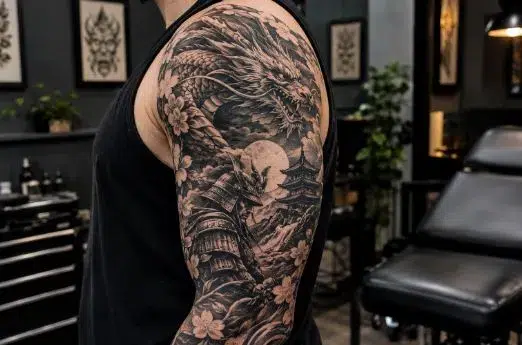
Large-scale tattoos need to be planned as one composition even when they are completed over several appointments. The artist has to consider how the design follows the body, where the eye lands first, how separate elements connect and what the piece will look like between sessions.
When you bring a large project to us, we begin with the whole idea. We want to understand the final area, the parts that matter most to you and the practical limits around sessions before we commit the first section to skin.
That early planning protects the idea from becoming a collection of individually good sections that do not quite belong together. For large-scale tattoos, Adelaide clients should arrive ready to discuss the whole project, practical limits and the parts that matter most.
What counts as a large-scale tattoo?
There is no strict measurement. A sleeve, back piece, chest panel, full leg or design crossing several body areas would usually be treated as large-scale. Some highly detailed half sleeves also require the same planning discipline.
The defining feature is not simply physical size. It is that the composition, appointments and healing periods depend on one another. Choices made in the first section can limit what is possible later.
Tell the artist the furthest extent you might eventually want, even if you plan to begin smaller. A forearm piece designed as complete in itself differs from the starting section of a future sleeve. Neither is wrong, but the artist needs to know which job the design is doing.
Begin with the central idea
Large projects often start with a long list: several subjects, background elements, lettering, dates and different references. Before deciding where everything goes, identify the central idea.
Ask yourself what somebody should notice first and what gives the project its emotional weight. Secondary elements can support that focus rather than competing with it.
You do not need to write an artistic brief. A few plain sentences are enough: “The bird is the main subject. These plants connect it to my family. I want the overall piece to feel calm rather than aggressive.” That tells the artist more than a folder of unrelated pictures.
Bring references for subject matter, mood, movement and colour, but do not expect them to be assembled like a collage. The artist’s job is to turn the idea into a coherent design suited to the body.
Choose a style that can carry the full project
Our artists work across custom, black and grey, colour, portrait, Japanese, fine line, realism, micro realism and large-scale tattooing. Each style handles outlines, texture, negative space and backgrounds differently, and we will explain which approach suits your idea.
A large Japanese composition, for example, follows established visual conventions and relationships between subjects. A realism sleeve may connect separate focal images through tone and background. A bold illustrative piece may depend on strong shapes and colour fields.
Mixing styles can work, but it needs intention. If an existing tattoo must be incorporated, show clear photographs and let the artist assess whether it can become part of the new visual language or should remain separate.
You can review our tattoo styles and service information before enquiring. We will then use the consultation to match your idea with an artist whose work supports that approach.
Why the body changes the drawing
A design is viewed on a moving, curved surface rather than a flat page. Lines wrap, muscles shift and a piece can look different from the front, side and back.
The artist may change the angle or proportions of a reference to follow the body. Important faces or small details need positions where they are not distorted every time a joint bends. Background movement can guide the eye around an arm or leg.
This is also why a perfect digital mock-up is not the final authority. The design needs to be assessed at scale on the person. Stencils may be adjusted so major shapes sit correctly from several viewpoints.
Wear clothing that allows the area to be viewed appropriately while preserving your comfort. Ask the studio what to wear before the consultation and each tattoo appointment.
Plan existing tattoos into the composition
Bring well-lit photographs of every tattoo near the proposed area. Include a straight view and wider images showing where each piece sits on the body.
An existing tattoo can be incorporated, framed, connected or left with deliberate space around it. The best option depends on its style, darkness, age and relationship to the new idea.
Do not assume background shading can make any two pieces match. Sometimes a visible boundary gives both tattoos more clarity. In other cases, repeating shapes, tones or colour can create a genuine connection.
If an existing area needs refreshing, we also provide a tattoo touch-up service. We will assess whether that work belongs before, during or after the larger project once we have seen the full area.
Work out a realistic session plan
Large-scale tattoos are normally completed over multiple sessions. The number and length cannot be responsibly promised without a design, size, style and individual discussion.
Ask how the project may be divided. An artist might complete linework first, work by body section, or finish selected areas before moving on. The sequence can depend on healing, visual balance and how comfortably you sit.
Leave room for the project to change. A section may take longer than expected, or the artist may adjust the next stage after seeing the healed work. A schedule is a plan, not a guaranteed completion date.
If you have a major event, holiday or work period that affects appointments, mention it early. Do not compress a large project into an unrealistic deadline.
Discuss cost without guessing
We quote after we understand the design, size, placement, detail, colour and likely session plan. A generic dollar amount would not describe your project accurately, so we explain the relevant costs during the booking process.
Ask how the studio quotes large work. Clarify whether estimates are given by session or project, what a deposit secures, and when payments are due. Also ask what happens if the design changes substantially.
Build a budget for the complete project, not only the first appointment. A large tattoo paused for financial reasons can remain visually unfinished longer than expected. There is no shame in spacing sessions to suit your circumstances; the artist simply needs to plan stages that make sense.
Before you pay anything, we will explain the booking, deposit, rescheduling and cancellation terms that apply to your project. Ask us about anything unclear. We would rather answer the question now than leave you guessing later.
Think about how the tattoo will look between appointments
A sleeve or back piece may be visible in an unfinished state for months. Ask which areas will be complete after each stage and whether outlines, shading or colour will be left open for the next appointment.
Some projects make visual sense at each pause. Others necessarily show unfinished sections. Knowing this in advance helps you choose timing around work, clothing and events.
Do not ask another artist to finish or alter a section mid-project without first discussing it with the original artist. Different methods and plans can make continuity difficult, and the artist needs a chance to address any concerns.
Allow proper healing time
Each session creates a healing area. The artist will decide how much can be tattooed safely and when the next section can proceed. Individual skin response, body area, session length and health can affect the plan.
Follow the aftercare instructions provided for your actual tattoo. General online advice cannot account for the products, method and condition the artist sees. Contact the studio if the healing process concerns you, and seek medical care for signs of infection or a significant reaction
Healing is part of the project timeline. Booking sessions too close together can interfere with the body and the artist’s ability to work around recovering skin.
Protect the work from Adelaide sun
South Australian sun is a practical consideration for a large tattoo, particularly on arms, legs and shoulders. Fresh work needs the specific protection advised by the artist while it heals. Once healed, reducing ultraviolet exposure helps protect skin and the appearance of tattoo pigment.
Think about timing if your work, sport or travel involves extended sun or water exposure. The studio can help you choose appointments that allow realistic healing, but it cannot change your commitments for you.
How to choose an artist for a large tattoo
Look for completed work at a comparable scale and in the style you want. A collection of excellent small tattoos does not automatically show how an artist handles a full back or connected sleeve.
Study composition from a distance as well as detail close up. Does the piece have a clear focus? Does it follow the body? Do background elements support the subject? Can you understand the design without examining every centimetre?
Communication matters over a project involving repeated appointments. You need to be comfortable asking questions, discussing limits and hearing that an idea needs adjustment.
We have worked in Adelaide since 2012 and welcome you whether this is your first tattoo or your fiftieth. We match large projects according to the style, scale and artists currently taking suitable work.
Prepare for the consultation
Bring:
- A short description of the central idea
- Reference images and an explanation of what you like in each
- Photographs of existing tattoos nearby
- The full area you may eventually want covered
- Work, travel or event dates affecting sessions
- Questions about quoting, deposits and rescheduling
- Any relevant skin sensitivities or health concerns to discuss
You are not expected to have every answer. The consultation exists to test the idea and establish what needs to be decided next.
Do not hide practical limits. If you can only attend on particular days, need shorter sessions or intend to spread the work over a long period, tell the artist. A plan built around reality is better than one that looks ideal on paper and cannot be followed.
Book a large-scale tattoo consultation in Adelaide
Large-scale tattoos Adelaide clients bring to us begin with a conversation about the complete project. Choose the focus, collect references and show us the entire body area and any existing work before we settle the first section.
For large-scale tattoos, Adelaide clients should also discuss how the design will look between sessions, not only when the complete project is finished.
We are at 230 Prospect Road, Prospect and work with clients from across Adelaide. Call us on (08) 8269 6383 or send us the outline of your large-scale tattoo idea. We will ask about the style, placement, references and scale before recommending the next step.
Frequently asked questions
1. How many sessions does a sleeve take?
There is no fixed answer. Design, detail, colour, body area, session length and individual healing all affect the number and spacing of appointments.
2. Do I need the whole design decided before starting?
The overall direction and boundaries should be clear, even if some secondary details develop later. Starting without discussing the full extent can limit future composition.
3. Can old tattoos be included in a new sleeve?
Often, but the approach depends on their style, darkness, location and condition. Bring clear photographs for assessment.
4. Can I change artists halfway through?
You can choose who works on your body, but changing methods mid-project can affect continuity. Discuss concerns with the original artist where appropriate and give any new artist complete information.
5. Can a large tattoo be completed for a fixed event date?
An artist can discuss a schedule, but session progress and healing cannot be guaranteed. Start early and avoid a deadline that depends on every stage going exactly to plan.