Some scars can be incorporated into or covered by a tattoo, while others should not be tattooed at that time. The scar needs to be fully healed and stable, and its cause, texture, colour, location and tendency to change all matter. A photograph can start the conversation, but it cannot replace seeing the skin or obtaining medical advice when the scar is active, raised or medically complex.
At Art n Soul, we treat scar-aware tattoo planning as a collaboration with clear limits. This guide explains what we look at before discussing a tattoo over scars in Adelaide, why scar tissue behaves differently, how design can work with texture, and when we will ask you to wait or speak with a health professional first.
A scar is not simply a different colour
Scar tissue forms as the body repairs an injury. Its collagen arrangement, thickness, blood supply, elasticity and sensation can differ from surrounding skin. Some scars become flat and pale; others remain red, raised, tight, indented or sensitive.
The history matters too. Surgical scars, burns, injuries, acne scars, stretch marks and self-harm scars do not all behave in the same way. Skin grafts and areas affected by radiation or reconstructive surgery require particular caution and medical guidance.
When is a scar ready to tattoo?
There is no single number of months that proves readiness. We look for a scar that has finished healing and remained stable, without open areas, scabs, active redness, increasing thickness, pain, itching or other ongoing change.
Before we consider tattooing, we ask:
- When did the injury or surgery occur?
- Has the scar changed recently?
- Is it raised, firm, itchy, painful or numb?
- Has it opened, ulcerated or become infected?
- Was a skin graft, radiation treatment or reconstructive procedure involved?
- Do you form keloids or thick raised scars?
- Has a doctor advised on tattooing the area?
- Are you taking medicine or managing a condition that affects healing?
If the answers raise uncertainty, we may request medical clearance or decline to tattoo the area. That is not a judgement about the scar or the person.
Scars we will not tattoo over immediately
Fresh, unstable or medically concerning skin needs healthcare, not pigment. We will not tattoo over:
- an open wound or unhealed surgical site
- active infection, discharge or spreading redness
- a scar that is still becoming raised or changing quickly
- unexplained ulceration or bleeding
- active dermatitis, sunburn or significant irritation
- a suspicious skin lesion or mole that needs medical assessment
- an area where a treating clinician has advised against tattooing
Why keloid history changes the conversation
Keloids are raised scars that grow beyond the boundaries of the original injury. Tattooing creates many small skin injuries, so a person with a keloid tendency may have additional scarring risk.
We cannot predict an individual outcome or perform a “test tattoo” that guarantees a larger piece will heal the same way. If you have developed keloids after piercing, surgery, acne or injury, discuss tattooing with a dermatologist or treating doctor first. Bring their advice to the consultation.
A medical opinion does not oblige an artist to proceed. We still assess whether the design, skin and studio risk are acceptable.
Can a tattoo make a scar invisible?
No tattoo can promise to make texture disappear. Pigment may change visual contrast, but raised, indented or shiny tissue can still catch light differently. Movement and touch may also reveal the scar.
A more realistic objective may be to:
- redirect attention towards a new focal point
- integrate the scar as a branch, line, texture or negative space
- reduce colour contrast through a broader composition
- frame rather than cover the scar
- build a design whose movement makes the scar feel intentional
| Scar feature | Design implication |
| Raised line | May remain visible through light and texture |
| Indented area | Shading can change visually as the body moves |
| Uneven colour | Pigment may heal differently across the area |
| Tight skin | Placement and movement need careful assessment |
| Reduced sensation | Lack of feeling does not remove injury or healing risk |
| High sensitivity | Session length and suitability may need reconsideration |
We use this table to set expectations, not to decide from a description alone.
Covering versus incorporating the scar
Covering tries to reduce how obvious the scar looks within a denser design. Incorporating uses its line or shape as part of the composition. Incorporation can sometimes require less saturation directly over the scar and produce a design that belongs to the area.
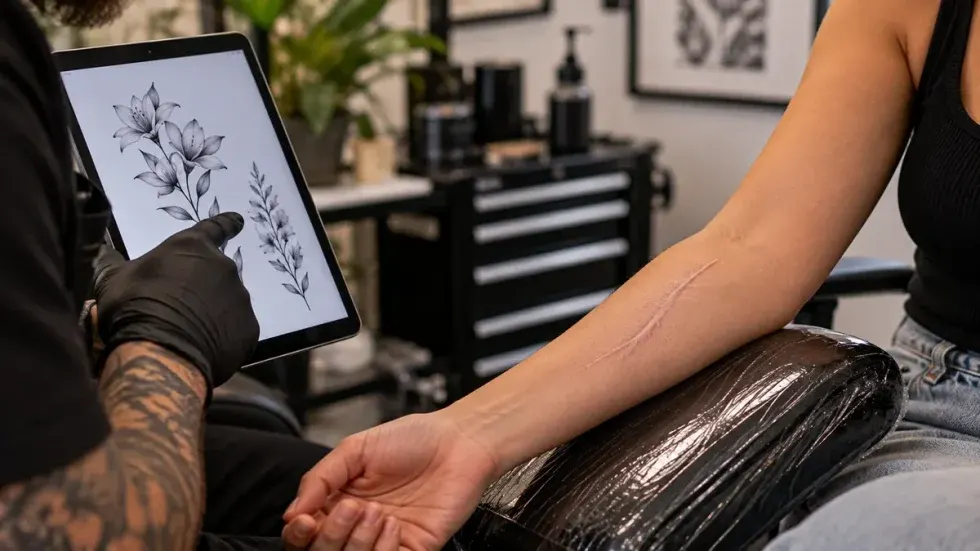
For example, a long line might become part of a botanical stem, landscape contour or abstract division. An irregular patch may sit inside textured leaves or black and grey shading. These are design possibilities, not templates that suit every scar.
Our cover-up tattoo service includes assessing existing tattoos and scars. If both old ink and scar tissue are present, we plan around two sets of constraints: pigment underneath and altered skin texture.
Which tattoo styles may work?
Style follows the scar and the desired visual result. Fine line is not automatically the gentlest option, and heavy black is not automatically the strongest cover.
-
Botanical and organic forms
Leaves, branches, petals and flowing natural shapes can follow irregular contours. They provide variation in edges and shading without requiring the scar to match a rigid geometric line.
-
Black and grey
Tonal work can create depth around an area, but smooth gradients may heal less evenly across textured tissue. The artist needs room to adjust contrast.
-
Colour
Colour can redirect the eye towards a focal point. It does not behave like opaque paint and cannot guarantee one flat colour across different tissue.
-
Abstract or illustrative work
Bold shapes and intentional negative space can incorporate a scar without pretending it is absent. This can suit someone who wants the design to acknowledge rather than conceal the area.
Bring style references and photographs of the scar. We may recommend a direction different from the one you expected after seeing how the tissue sits when you move.
What about stretch marks?
Stretch marks are a form of dermal scarring. Newer marks may be red, purple or changing, while older marks often become paler. Stability, texture, location and skin tension matter.
Tattooing across mature stretch marks may be possible in selected cases, but lines and shading can heal differently where the skin is thinner or textured. Future body changes, pregnancy, muscle gain or weight change can also alter the area and tattoo.
We do not promise that a tattoo prevents stretch marks from showing or that the design will remain unchanged through major skin change.
Medical and reconstructive tattooing are separate services
Decorative scar tattoos are not the same as paramedical pigmentation, nipple-areola tattooing after reconstruction or pigment matching for medical conditions. These services may require specific training and clinical coordination.
Art n Soul offers artistic tattooing, cover-ups and touch-ups. We do not describe our service as medical treatment. If your goal follows breast reconstruction, skin grafting or significant surgery, begin with the treating medical team and seek a suitably qualified practitioner for the required service.
Preparing photographs for an initial enquiry
Photographs help us decide whether a studio consultation is sensible. They should be clear and honest rather than filtered.
Send:
- A close image in natural light.
- A wider image showing body placement.
- Side lighting if the scar is raised or indented.
- An image of the area relaxed, not stretched.
- The approximate age and cause of the scar.
- Notes about sensation, symptoms and recent changes.
- Reference images for the tattoo direction.
Do not include medical information you are uncomfortable sending electronically. You can tell us that clinician advice is available and discuss details privately.
What happens at the consultation?
We examine the skin visually, discuss the history relevant to tattooing and look at how the tissue moves. We then compare the proposed style and size with the actual area.
The outcome may be:
- proceeding to a design and booking
- changing the style, size or placement
- working around rather than directly over the scar
- waiting longer and reassessing
- asking for medical advice
- declining to tattoo that area
You should leave understanding the limitations, not with a guarantee. If we cannot responsibly do the work, we will say so plainly.
Pain and sensation may be unpredictable
Scar tissue can be numb, sensitive or inconsistent. Reduced sensation does not mean tattooing causes no tissue stress, and a small numb area does not predict the feeling in surrounding skin.
Tell the artist about unusual sensation before the session. We can discuss breaks and session length, but we will not call the process painless. Sudden severe pain, unexpected skin response or another concern may mean stopping and reassessing.
Do not apply numbing products unless the artist has agreed and you have followed product and health advice. Ingredients can affect skin and carry their own risks.
Healing and when to seek care
Follow the aftercare given for the tattoo. Keep the area clean, avoid soaking, do not pick and protect it from friction and sun while healing. Scarred skin may not look identical to surrounding skin during recovery.
Contact us with non-urgent tattoo-care questions. Seek prompt medical care for spreading redness, increasing warmth, pus, fever, worsening swelling, significant pain or red streaking. If an old scar begins changing independently of the tattoo, arrange medical assessment.
Once healed, we assess the result before deciding whether any additional work is appropriate. Reworking too early can injure skin that has not settled.
Questions to ask the artist
- Have you seen the scar in person as well as in photographs?
- Which parts will be tattooed directly and which will be worked around?
- What texture is likely to remain visible?
- Does the design need to be larger than the scar?
- Would another style suit the tissue better?
- Should I seek medical advice first?
- How will the session be staged?
- When will healed work be reviewed?
Honest limits are part of a good consultation. Be cautious of anyone promising that every scar can be hidden completely.
Discuss a tattoo over scars in Adelaide
Art n Soul has worked with Adelaide clients since 2012 at 230 Prospect Road, Prospect. We aim to make scar and cover-up consultations respectful, practical and free of judgement.
If you are considering a tattoo over scars, Adelaide clients can send us a clear enquiry with the scar’s age, location and design direction. You can also call us on (08) 8269 6383. We will tell you whether the next step is a studio consultation, more healing time or medical advice.
Frequently asked questions
1. How old must a scar be before tattooing?
There is no universal age. It must be fully healed and stable, and some scars need medical assessment regardless of age.
2. Can a tattoo flatten a raised scar?
No. Tattooing adds pigment; it doesn’t treat raised scar tissue. A dermatologist or other medical professional should advise on scar treatment.
3. Can you tattoo over self-harm scars?
We can respectfully assess mature, stable scars without asking you to justify them. Medical and emotional readiness still matter, and not every scar will be suitable.
4. Will the ink look the same on scar tissue?
Not always. Texture and tissue differences can affect how pigment settles and how light reflects. We discuss that uncertainty before booking.