
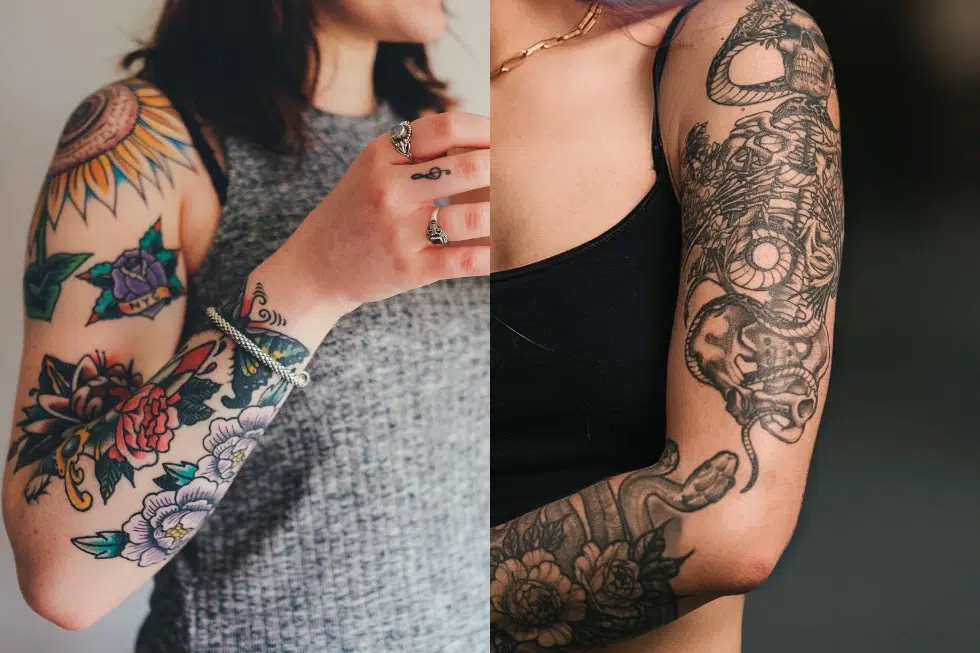
So you’ve decided you want new ink, but now you’re stuck on the big question: do you go colour or black and grey? It’s one of the most common conversations that happens at a consultation, and honestly, it’s one worth having properly. Because this tattoo choice goes a lot deeper than just picking what looks cool on the wall.
Whether you’re in Prospect, Adelaide or anywhere across South Australia, this guide will help you decide, by walking through the real differences between colour and black and grey tattoos: how they’re made, how they age, which styles they suit, and what it all means for your skin and your budget.
How Colour and Black and Grey Tattoos Are Different Technically
At their core, both approaches use ink deposited into the dermis layer of your skin. But the way each is applied, and what that creates, is pretty different.
- Black and grey tattoos use black ink to create a range of tones by diluting the ink with water or a grey wash. The artist works with shades of grey, using contrast and negative space to build depth and dimension. Smooth gradients, fine shading, and subtle transitions are the hallmarks of this style.
- Colour tattoos use a much wider palette of colour pigments, each with its own formulation, saturation, and behaviour under the skin. Layering is everything here. To get vibrancy in a colour piece, an artist needs to build up the ink in passes, which often means more sessions and more healing time.
The application process for colour work is generally more complex. Colour pigments require more precision to lay down evenly, and the healing process can be slightly more involved, particularly for large blocks of solid colour.
Longevity and Maintenance: Which Holds Up Better Over Time?
This is where things get really practical, especially for anyone getting a tattoo in South Australia.
- Black ink is the most stable pigment available. It’s carbon-based, dense, and holds its structure longer than any colour alternative. Black and grey tattoos age predictably, softening into lighter grey tones over the years rather than shifting colour or becoming muddy.
- Colour tattoos are more susceptible to fading. Lighter colours like yellow, pink, white, and pastels fade more quickly and may need a touch-up within a few years. Darker colours like navy, forest green, and deep red hold better than pastels, but they still require more maintenance than black and grey pieces.
Here’s a general breakdown of how long different ink colours typically last before needing attention:
| Ink Colour | Approximate Longevity Before Touch-Up |
| Black ink | 10+ years (fades gradually to grey) |
| Dark blue, dark green | Up to 10 years |
| Red, orange, purple | Around 8 years or more |
| Pastels, white, light pink | 5 to 8 years |
| UV/glow-in-the-dark ink | 3 to 5 years |
The Australian sun is a major factor here. UV rays break down tattoo pigments in the skin, and Australia experiences some of the highest UV radiation levels in the world due to our proximity to the equator and the number of clear-sky days we get year-round. Adelaide specifically sees UV index levels that reach extreme ratings (12 to 15) between November and March, with burn times as short as 10 minutes during peak summer months.
For colour tattoos, this is a big deal. UV rays break down colour pigments significantly faster than black pigment, which means if you’re spending time outdoors in Prospect during summer without protecting your ink, that colour tattoo will fade more quickly than it otherwise would. Research suggests that applying SPF 50+ daily can extend tattoo life by 10 to 15 years, which is worth knowing if you’re investing in a detailed colour piece.
Most tattoo artists recommend a touch-up every 5 to 10 years, depending on the colours used, placement, and how well the tattoo has been cared for. For colour work in a sun-heavy climate like South Australia, that window can be on the shorter side.
Style Compatibility: Which Styles Suit Each Approach?
Your tattoo style will often dictate the colour vs black and grey decision before anything else does. Here’s a quick reference:
Styles that work best in black and grey:
- Grey realism and portrait work
- Fine-line tattoos
- Japanese tattoos and traditional Japanese pieces
- Geometric and dotwork
- Illustrative black and grey pieces
- Blackwork
Styles that work best in colour:
- Traditional and neo-traditional
- New school
- Watercolour
- Colour realism
- Some illustrative and comic-style work
Styles that can go either way:
- Geometric work can be done with colour accents.
- Some Japanese tattoos incorporate heavy colour alongside bold lines.
- Realism (both black and grey realism and colour realism are their own disciplines)
If you’re already drawn to a particular style, that will often make the colour vs black and grey question answer itself. A grey realism portrait is timeless in black and grey. A neo-traditional floral piece lives and breathes in colour. Chat to your artist at the consultation about what approach suits the specific design you have in mind.
Skin Tone Considerations
Skin tone plays a real role in how tattoos look, both fresh and over time.
- Lighter skin tones: Both colour and black and grey work well. Colour tattoos show the most brightness and vibrancy on pale skin, with even delicate pastels reading clearly.
- Medium to olive skin tones: Darker colours like blues, greens, blacks, and deep reds show beautifully. Pastels and light colours can look muted or wash out over time.
- Darker skin tones: Bold lines and high-contrast black and grey tattoos perform strongly. Colour work can still look great, but tends to work better with rich, saturated tones rather than light pastels or whites.
There’s a lot more depth to this topic, which is why we’ve covered it separately. If your skin tone is a primary concern, check out our dedicated skin tone and tattoos article for a fuller picture.
Cost Differences Between Colour and Black and Grey
It’s worth knowing that colour work and black and grey are priced differently at most studios, though the relationship between the two isn’t always what people expect.
A few things to keep in mind:
- Some colour pigments cost more to source, and that can be reflected in studio pricing depending on the artist and the colours involved.
- Colour tattoos often require more sessions. Building up vibrancy takes time, and complex colour pieces may need multiple sittings to complete.
- Touch-ups are more frequent with colour tattoos. Over the life of a colour piece, you may be going back every few years to refresh the ink colour, particularly for lighter tones.
- Black and grey work isn’t necessarily cheaper. Highly detailed black and grey realism or Japanese tattoos demand significant skill and time. The cost reflects the artistry, not just the ink.
For accurate pricing, the best approach is always to book a consultation and get a quote specific to your design. Prices vary between artists and studios, and what you pay is really a reflection of the experience and skill going into your piece.
Making the Decision: Questions to Ask Yourself Before Booking
Still not sure which way to go? Here are a few questions that can help you decide:
- What style am I drawn to?
Let the style lead the decision. Looking for a tattoo with realism and depth in a classic and timeless finish? Black and grey might be your answer. Want something eye-catching and full of energy? Colour could be the way to go. - How much maintenance am I willing to put in?
If you’d rather get it done and not think too much about it, black and grey tattoos are generally lower maintenance. - Where is the tattoo going?
Sun-exposed placements like forearms, shoulders, and calves, combined with bright colour means higher maintenance in the Australian climate. - What’s my skin tone?
As mentioned above, this has a real impact on brightness and vibrancy over time. - What’s my pain tolerance?
Grey tattoos are less painful than colour tattoos for some people, since colour work can involve more passes and longer sessions. That said, pain experience varies a lot by individual and placement. - Is this my first tattoo?
If you’re getting a tattoo for the first time, starting with a black and grey piece can be a good way to understand how your skin responds before committing to a longer colour session.
At the end of the day, the best tattoo is one that fits your personality and vision, and one that’s been done by the right tattoo artist using quality ink.
A Note on Melbourne vs Adelaide Tattoo Trends
It’s worth noting that tattoo culture in Australia is vibrant and diverse across cities. Melbourne, in particular, has a well-established tattoo scene, with Melbourne artists and studios often setting trends that flow out to the rest of the country, including here in Adelaide and Prospect. Melbourne’s influence on fine-line and black and grey work in particular has been significant over the last few years. Melbourne studios have also helped push colour realism into the mainstream, with clients from Melbourne to Perth seeking out specialised artists in both fields. That said, South Australian clients don’t need to travel to Melbourne for quality work: the local scene, including right here in Prospect, has grown considerably.
Come In and Talk It Through
Choosing between colour and black and grey isn’t always a decision you need to make alone. At Art n Soul Tattoo in Prospect, our tattoo artist can sit down with you, look at your design ideas, consider your skin tone and placement, and give you an honest recommendation on which approach will work best for your specific piece.
Whether you’re after the classic elegance of a black and grey piece or a bold, eye-catching colour tattoo, we’re here to help you choose the style that truly fits.
Book a consultation with the team at Art n Soul, and let’s talk about your next tattoo
Frequently Asked Questions
Do colour tattoos hurt more than black and grey?
They can. Grey tattoos are less painful than colour tattoos for some clients because colour work often involves more passes over the same area to build saturation. That said, pain tolerance varies significantly by person and placement.
1. How often do colour tattoos need a touch-up?
Most colour tattoos benefit from a touch-up every 5 to 10 years, though lighter colours in sun-exposed areas may need attention sooner, especially in a high-UV climate like South Australia.
2. Are black and grey tattoos better for darker skin?
Black and grey tattoos and bold colour work generally perform better on darker skin than light pastels or whites, which can appear muted. See our skin tone article for a deeper breakdown.
3. Which style ages better, colour or black and grey?
Black and grey tattoos age more predictably. Colour tattoos, especially lighter shades, are more susceptible to fading over time, particularly with ongoing sun exposure.
4. Can I convert a colour tattoo to black and grey later?
In some cases, yes. A skilled tattoo artist can rework or cover an existing colour piece in black and grey, though this depends on the original design and how the ink has settled. A consultation is the best way to find out what’s possible.