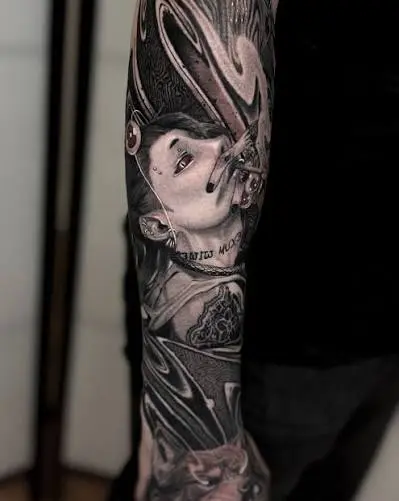
A strong reference for a portrait tattoo is clear, well lit and detailed enough for an artist to understand the features that make the subject recognisable. It does not have to be professionally photographed. It does need to show the face, expression and proportions without heavy filters, blur or important areas hidden in shadow.
When you bring an idea to us, we are not looking for a perfect studio photograph. We are looking for enough honest visual information to understand the person, pet or character you want represented and the details you care about most.
That matters because portrait tattoos are not copied by a machine. An artist interprets a photograph for skin, taking account of size, contrast, placement and how the work needs to remain readable over time. For portrait tattoos Adelaide clients can feel confident planning, collecting the right source material is one of the most useful things you can do before enquiring.
Begin with the image that feels like the person
Technical quality matters, but recognition is not only about pixels. Families often have one photograph that captures a familiar expression, posture or glance. That emotional accuracy may matter more than choosing the sharpest image in the folder.
Start by selecting several possibilities rather than trying to decide alone. Include the photograph you love and any clearer images that show features obscured in it. An artist may be able to use one image for the composition and another to understand an eye, hairstyle or piece of clothing.
For a pet portrait, include photographs showing characteristic markings and coat texture. For a fictional character or public figure, bring legitimate reference material and be open to discussing how an existing image can be interpreted rather than reproduced without thought.
The aim is not to arrive with a finished tattoo design. It is to give the artist enough visual information to develop one.
What makes a photograph technically useful?
A useful portrait reference generally has four qualities:
- The face or subject is in focus.
- Light reveals the features rather than flattening or hiding them.
- The image is large enough to inspect closely.
- The angle supports the composition you have in mind.
Original files are better than screenshots saved repeatedly through social media. Each round of compression can remove fine information. If a relative has the original photograph, ask them to send the full-size file rather than a screenshot of their screen.
Avoid beauty filters where possible. Filters can change facial proportions, smooth away defining lines and alter the relationship between light and shadow. The result may look pleasing on a phone while giving the artist less reliable information.
Prints can still be valuable, especially for older family photographs. Bring the physical photograph in a protective sleeve and a high-resolution scan if one is available. Do not hand over the only copy without agreeing on how it will be handled and returned.
Can an old or damaged photograph still work?
Sometimes. A faded, creased or small photograph may still contain enough information, particularly when other images can fill in missing details. The artist needs to see it before giving a responsible answer.
Digital restoration can help make damage easier to interpret, but it can also invent detail. Automated tools may change eyes, teeth, hair or skin texture while making the result look convincing. If you use a restored image, bring the original too and explain what was altered.
Where no supporting image exists, the artist may recommend a different approach. A simplified portrait, silhouette, framed object, handwriting or another symbol connected to the person can carry meaning without pretending to reproduce details that are not visible.
That is an honest design decision, not a lesser one. A clear piece built around reliable information will usually make more sense than forcing photographic realism from a source that cannot support it.
Black and grey or colour?
Both can work for portrait tattoos. The choice depends on the reference, the intended mood, the available space and the artist’s assessment.
Black and grey portrait work uses value and contrast to create form. It can suit historical photographs, restrained memorial pieces and references where colour information is poor. Colour can preserve distinctive eyes, clothing, fur or background elements, but the palette needs to be planned for skin and for the scale of the piece.
A colour photograph does not require a colour tattoo, and a monochrome photograph does not make colour impossible. Bring references that show any colours that must be accurate and tell the artist which details carry personal meaning.
We work across both black and grey and colour tattoo styles. During the consultation, we can compare what each treatment would do for your particular image and explain the trade-offs clearly.
Why size matters in portrait tattoos
Faces contain small relationships that make them recognisable. The distance between features, edge of a smile, shape of an eyelid and fall of a shadow all contribute. When a portrait is made very small, there is less room to separate those details.
Skin is also a living surface. Lines and tones settle and change over time. An artist may recommend making the portrait larger, simplifying part of the reference or adjusting the crop so the important features have enough room.
This is one reason a photograph that looks detailed on a bright screen cannot simply be reduced to any size. The question is not whether the artist can place tiny marks there on the day. It is whether the design remains clear after healing and ageing.
Ask what the proposed dimensions allow the artist to keep and what needs to be simplified. That conversation gives you a more realistic picture than choosing size from price or available space alone.
Choosing the crop and composition
A photograph may include a full scene when the tattoo needs one focal point. Cropping changes the emphasis and can make a portrait more readable.
Decide whether you want a head-and-shoulders portrait, a closer facial crop, a full figure or a scene with meaningful objects. Consider where the subject looks. A profile facing out of the composition can feel different from one directed towards another element.
Backgrounds deserve restraint. Dates, flowers, handwriting, landscapes and decorative frames can add meaning, but each uses space and competes for attention. Bring all your ideas, then let the artist help establish a hierarchy.
For multiple people or pets, do not assume separate photographs will combine naturally. Differences in lighting, camera angle and image quality can make a group composition difficult. The artist may suggest individual panels or a layout that acknowledges those differences.
Memorial portraits need room for a careful conversation
A memorial tattoo can carry grief as well as affection. There is no correct timetable for deciding, and you never need to give us a dramatic explanation for why the image matters.
Bring a trusted person if that makes the discussion easier. Write down dates or names rather than relying on memory during an emotional appointment, and check every letter and number on the final design yourself.
An artist may advise changing a reference or simplifying an element. That advice concerns how the design translates, not the value of the person or memory. You remain in control of whether to proceed.
Do not feel pressured to combine every meaningful object into one piece. A portrait with one well-chosen detail can say more than a crowded collection of symbols.
What should you tell the artist?
Share the facts that affect the design:
- Who or what the portrait depicts
- Which photograph is emotionally important
- Which features must remain recognisable
- Whether colour has a particular meaning
- Approximate size and body area you are considering
- Existing tattoos near the area
- Any date, name or handwriting to include
- Whether you are open to cropping or simplifying the reference
You do not need to know tattoo terminology. Saying “I want this expression, but I do not need the whole background” is more useful than trying to prescribe a technique.
If the portrait is of a pet, mention distinctive markings that photographs may not show accurately. If it is based on artwork created by someone else, disclose the source so the artist can discuss an original interpretation.
How to compare portrait tattoo artists in Adelaide
Look closely at healed and fresh work where available, while remembering that images online may vary in lighting and age. Do not judge only by follower count or a single dramatic piece.
Study whether faces remain recognisable without relying on a caption. Look at transitions between light and dark, treatment of eyes and hair, and whether the amount of detail suits the tattoo’s size.
Then pay attention to communication. A good discussion should cover limitations as well as possibilities. An artist who recommends a larger size or a different reference is not being difficult; they are showing you the constraints before the work is permanent.
What happens after you send the reference?
We may ask for more images, clarify the size and location, or recommend a consultation. Our artist then considers how the photograph can be translated into a tattoo design that works on your body.
Do not expect a completed custom design before the booking process and deposit terms are agreed. Design work is part of the artist’s labour. Ask when you will review the concept and what changes can reasonably be made.
On the day, examine the final design and stencil carefully. Check orientation, names, dates and the relationship between elements. Speak up before tattooing begins if something does not feel right.
We have worked with first-time and experienced clients in Adelaide since 2012. You will find us at 230 Prospect Road, Prospect, where our artists work across portrait, realism, colour, black and grey and other tattoo styles.
Plan your portrait tattoo in Adelaide
Choose several references, find the highest-quality versions and note what you most want the portrait to preserve. When we plan portrait tattoos in Adelaide, clients often bring one meaningful image plus clearer supporting photographs. That preparation gives our tattoo artist a strong starting point without locking the design before we have discussed how it will work on skin.
The strongest portrait tattoos Adelaide clients can plan begin with honest source material and enough room for the artist to interpret it clearly.
To talk through portrait tattoos in Adelaide, call us on (08) 8269 6383 or send us the idea through our tattoo service page. Include the approximate size, proposed body area and the best reference images you have. We will tell you what else we need.
Frequently asked questions
-
Can a portrait tattoo be made from one photograph?
It may be possible if the photograph contains enough clear information. Extra images can help the artist understand features hidden by lighting, angle or damage.
-
Can two separate photographs be combined?
Sometimes, but differences in angle and light can affect the composition. Show both images before assuming they will work together naturally.
-
Does a portrait tattoo have to be realism?
No. Portrait subjects can be interpreted through different tattoo styles. The right approach depends on the meaning, reference and look you want.
-
How small can a portrait tattoo be?
There is no universal minimum. The detail in the reference and design determines the space needed. Let the artist explain what can remain readable at the proposed size.
-
Should I edit the photograph before sending it?
Send the original where possible. You can also send a crop or edited version to show your idea, but label it clearly and avoid relying only on an automated restoration.