
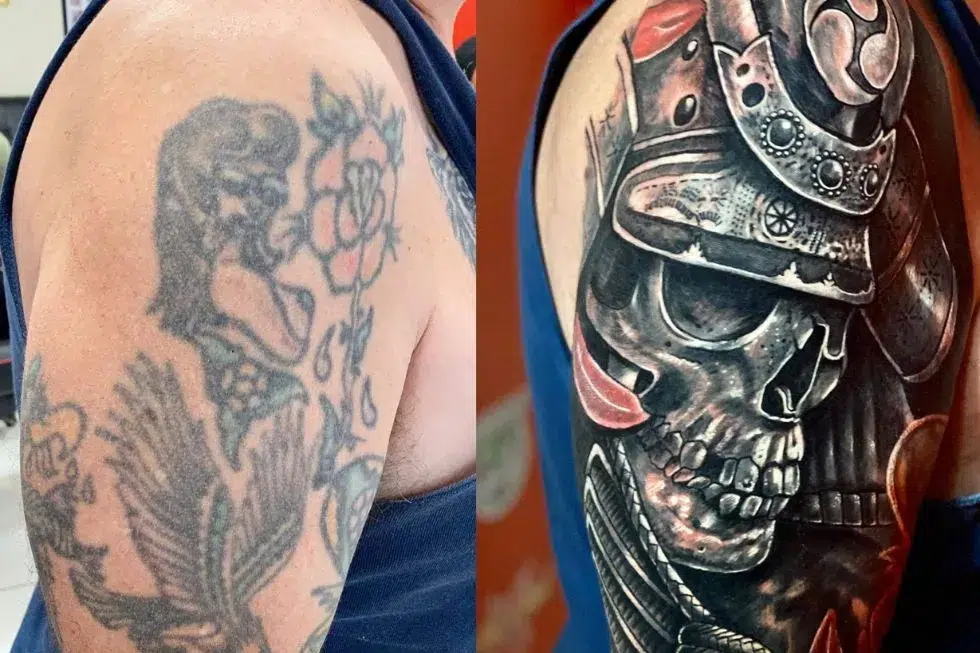
There’s a saying that floats around tattoo studios: a cover-up that still shows the original tattoo is not a cover-up. It’s just two problems sitting on top of each other.
At Art n Soul in Prospect, cover-up work is a speciality, not an afterthought. This article walks you through why old tattoos show through, what skilled tattoo artists do differently, and how to make sure you get it right this time.
Why Does Your Old Tattoo Still Show Through? The Ink Density Problem
This is the number one question people ask after a failed cover-up, and the answer usually comes down to one factor: ink density.
When a new tattoo is placed over an existing one, the old ink is still sitting in your skin. It does not disappear. The new design has to be dark and dense enough to visually block what is underneath. When that does not happen, the old tattoo bleeds through like a shadow.
Here are the main reasons it goes wrong:
- The new design was not dark enough. Light or pastel colours will never fully conceal a dark original tattoo on their own.
- The design was not large enough. A new tattoo must be bigger than the original to cover all the edges properly. It is one of the most basic rules, and one of the most often ignored.
- Not enough contrast. The new artwork needs a strong contrast to draw the eye away from what is underneath.
- The artist did not factor in the existing tattoo. Some artists treat the skin like a blank canvas and design something without properly assessing what they are working on. That is a recipe for a visible remnant of the old design.
- Scar tissue from the original tattoo. Old ink, especially amateur work, can leave scar tissue that affects how new pigment sits in the skin.
- The style chosen does not suit a cover-up. Fine-line work, watercolour, and minimalist designs rarely have the coverage needed to conceal darker original tattoos.
What a Skilled Cover-Up Artist Does Differently at the Planning Stage
The planning stage is where a good cover-up is made or broken. This is what separates a skilled artist from someone who will just place a new tattoo over the old one and hope for the best.
A proper cover-up consultation should include:
- A thorough assessment of the existing tattoo. The artist needs to look at the colour, size, placement, and ink density of the original before anything else. This is the crucial step that many studios skip.
- An honest conversation about what is achievable. Not every old tattoo can be covered in a single session. A good artist will tell you this upfront rather than promising something they cannot deliver.
- A custom design brief. The new tattoo must incorporate the shape and placement of the original, using it to inform the new artwork rather than ignoring it entirely.
- Size and darkness mapping. The new design generally needs to be at least 20-30% larger than the original, and darker in the areas where old ink sits heaviest.
- Style selection that suits the job. Not every style works for cover-ups. The artist should recommend the right approach based on what is underneath, not just what looks good on paper.
Tattoo Cover-Up Styles That Actually Work
The style of your new tattoo matters enormously when it comes to coverage. These are the styles that tattoo artists most often recommend for cover-up work:
- Bold blackwork. Solid black and heavily saturated designs are the gold standard for cover-ups. They provide maximum coverage and are designed to conceal darker original tattoos effectively.
- Neo-traditional. This style uses strong outlines and rich, saturated colour fields, giving the artist the density they need to cover and create something genuinely beautiful.
- Dark floral. Large-scale floral designs with deep, lush colour are a popular choice, especially when the goal is to change a symbol or name into something more personal.
- Geometric. Bold geometric patterns use dense line work and shading to cover old ink while creating striking new artwork. The structured nature of geometric designs makes them well-suited to working around existing tattoo shapes.
What generally does not work: fine-line designs, light watercolour washes, anything bright and pastel, or anything with significant negative space directly over old ink. If an artist is recommending any of those for a heavy cover-up without laser fading first, that should raise a flag.
Can a Failed Cover-Up Be Fixed? Correction Work Explained
Yes, it can be fixed. But it takes skill, honest assessment, and in some cases, more than one approach.
If you are dealing with a faded or poorly done cover-up, here is what the correction process typically looks like:
- Assessment first, always. An in-person consultation is non-negotiable. Photos can give a rough idea, but a proper assessment needs to happen under proper lighting with the artist looking directly at your skin.
- Additional coverage may be possible. Depending on the current state of the cover-up, a skilled artist may be able to layer additional work to address what is showing through.
- Laser fading may be recommended before further tattooing. For heavily saturated areas, it may be necessary to fade the existing work before applying more ink.
- Budget for the process, not just the session. Corrections often require multiple sessions, and rushing the outcome never helps the healing process.
Art n Soul’s corrections gallery shows real examples of this kind of work. If you are not sure whether your cover-up can be salvaged, that is the best starting point.
When Laser Fading Makes Sense Before a Tattoo Cover-Up
Laser fading before a cover-up is not always necessary, but for very dark or heavily saturated original tattoos, it can make an enormous difference to the final result.
Here is the logic: laser removal does not need to fully remove the tattoo. It just needs to lighten the old ink enough to give the cover-up artist more to work with. Fewer sessions are required, the cost is lower, and the cover-up has a much better chance of looking clean and lasting well.
Australia’s tattoo removal market is growing rapidly, valued at $15 million in 2023 and projected to reach $92.4 million by 2033, which reflects just how many people are seeking solutions for unwanted ink. Allied Market Research: Laser treatment has become far more accessible and effective than it was even five years ago.
A few things worth knowing about laser fading before a cover-up:
- Green and yellow inks are the hardest colours to fade via laser. Worth knowing if your original tattoo has either.
- Multiple sessions are standard. Waiting between laser sessions allows the skin to heal properly before the next round.
- It is not always necessary. For lighter or older originals that have already begun to fade naturally, an experienced cover-up artist may be able to work without it.
The best approach is to ask at your consultation. A good artist will give you an honest answer about whether laser fading would genuinely improve the outcome for your specific tattoo.
What happens at an Art n Soul Cover-Up Consultation in Prospect
Art n Soul is one of Adelaide’s top 3 tattoo studios, and cover-up consultations here are thorough by design. Here is what you can expect:
- A proper look at your existing tattoo. The artist will assess the ink density, colour, size, and placement in person.
- Honest guidance on what is and is not achievable. If the original tattoo needs laser fading first, you will be told that clearly, not after the fact.
- A design conversation grounded in reality. The goal is an outcome you will love long-term, not just something that looks good in a photo immediately after the session.
- Style and coverage recommendations tailored to your skin. Every cover-up is different. A 5-10-year-old name tattoo requires a completely different approach to a dark tribal sleeve, for example.
Roughly half of the people who begin the tattoo removal process end up opting for a cover-up tattoo instead of full removal. That tells you something about how appealing a great cover-up is when it is done well. It also means there is a lot of work out there being done to varying standards.
If you are in Melbourne, Sydney, or anywhere else in Australia considering a cover-up, the same principles apply wherever you seek guidance. Look for a studio with a genuine corrections gallery, not just portfolio shots of easy work. Do not let geography be the reason you settle.
Art n Soul serves clients from across Adelaide, Prospect, and regularly sees people travelling in from Melbourne and beyond who want the job done properly.
Get an Honest Cover-Up Assessment at Art n Soul, Prospect
Do not get burned twice. If your existing tattoo is not what you hoped for, or if a previous cover-up has left you with something you are still trying to conceal, the first step is a real, in-person consultation with tattoo artists who specialise in this work.
Art n Soul’s team will look at your tattoo, give you an honest assessment of what is possible, and design a solution that is built to last.
Book your cover-up tattoo consultation at Art n Soul, Prospect, today.
Frequently Asked Questions
1. Why is my old tattoo still showing through my cover-up?
Most likely, the new tattoo was not dark or large enough to fully conceal the original ink. Cover-ups need density and size to work properly.
2. Can any tattoo be covered up without a laser?
Lighter and older tattoos often can be, but very dark or heavily saturated originals usually respond better if the old ink is faded with a laser first.
3. How much bigger does a cover-up tattoo need to be?
As a general guide, the new design needs to be noticeably larger than the original and darker in the areas where old ink is densest.
4. Does a cover-up tattoo hurt more than a regular tattoo?
It can, particularly over areas with existing ink or scar tissue. Your artist can advise based on the condition of your skin.
5. How do I know if my failed cover-up can be fixed?
The only reliable way to assess this is an in-person consultation. Photos help, but a skilled cover-up artist needs to see the tattoo directly to give you an honest answer.