
One of the most common regrets in tattooing is size. Not the design. Not the style. The size. Either it’s too small to hold the detail it needs, or it’s too large for the spot it’s sitting on. And unlike most purchases you’ll ever make, you can’t return a tattoo that’s the wrong size.
According to McCrindle research, one third of Australians with tattoos say they regret, to some extent, getting a tattoo. That’s a significant number, and when you talk to artists across studios in Adelaide, Sydney, and Melbourne, a huge chunk of that regret traces back to one avoidable mistake: not getting the sizing right from the start.
This guide is for clients in Prospect who want to walk into a consultation informed, confident, and ready to make a decision they’ll be happy with for years to come.
Why Tattoo Size and Placement Matter More Than You Probably Think
Most people spend hours choosing a tattoo design and about five minutes thinking about the size. That’s the wrong way around.
Size affects everything: how much detail an artist can fit in, how the piece sits on the body, how it will look in ten years, and whether the whole composition reads well visually. A design that looks stunning at A4 size on a reference photo from Instagram can completely fall apart when it’s scaled down to fit on a wrist.
Here’s why the size decision is so important:
- Too small means fine details like shading, linework, and lettering compress into each other over time and blur.
- Too large can overwhelm a placement and look disproportionate on the body.
- Poorly matched size and placement affect the visual balance of the entire piece.
- Undersized tattoos tend to be the ones people regret most. Research shows that small tattoos account for the most regret cases, likely because people get tiny tattoos on a whim with little thought compared to an expansive back piece.
The good news? This is entirely avoidable with the right tip or two before you book your appointment.
How Tattoo Style Affects the Minimum Size You Should Choose
Not every tattoo style works at every size. This is something Melbourne and Adelaide artists talk about constantly at consultations, and it’s one area where clients tend to underestimate how much the style dictates the size requirements.
-
Fine Line and Realism
Fine line work is popular right now, and for good reason. It looks incredible fresh off the needle. But it needs room to breathe.
According to the 2025 Australian Tattoo Insights Report, 67% of minimalist tattoo clients notice fading within 2 years. A&A Law Associates Fine line tattoos rely on precision and subtlety, and over time, lines may soften and lighten slightly. The risk is not careful aging, but poor application that leads to premature blurring or disappearing lines.
If a fine line design is too small, those thin lines sit too close together and eventually blur into each other. An artist in Adelaide or Melbourne will often recommend sizing up slightly to give each line room to age with some dignity.
-
Traditional and Neo-Traditional
Bold, thick lines are the reason traditional and neo-traditional tattoos still look sharp on collectors who’ve had their ink for 20, 30 years. Big, simple shapes survive time better than small, delicate lines. Traditional tattoos use bold lines and dense ink packing, meaning they hold their shape aggressively, often thickening slightly over decades. MetaFilter
This style is more forgiving at smaller sizes, but even here there are limits. Your artist will let you know when a design starts losing integrity.
-
Lettering and Script
Script is one of the most commonly requested tattoo requests. Letters need a minimum height to stay legible as the skin changes. Too small and within five to ten years, you’ll have something that looks more like a smear than a quote.
A good artist will tell you the minimum letter height for your specific font and script style, and they won’t budge on it. That’s not them being difficult. That’s them protecting your investment.
-
Micro Tattoos
Micro tattoos are the exception to most sizing rules, but they come with their own strict design requirements. Intricate detail simply doesn’t work at the micro scale. If you’re considering something small, check out our [micro tattoo tips article] for what actually works at that size.
Matching Your Tattoo Size to Its Placement on Your Body
Placement and size are a package deal. You can’t decide one without considering the other.
| Placement | General Size Guidance | Key Consideration |
| Wrist | Small to medium (4–7 cm) | Curved surface distorts wider designs |
| Forearm | Small to large (6–20 cm) | One of the most versatile placements |
| Upper arm | Medium to large (8–20 cm) | Works well for bold pieces and sleeves |
| Ribs | Medium to large (10–25 cm) | Movement and skin stretch affect healing |
| Thigh | Large (15–30 cm+) | Excellent canvas, heals well, suits most styles |
| Back | Full range, including large-scale work | Best area for complex, detailed designs |
| Ankle/foot | Small (3–6 cm) | High friction, fades faster, size up slightly |
| Fingers | Very small (1–3 cm) | Fades fastest of all placements |
A few placement-specific tips:
- Curved surfaces like the ribs and forearm can distort designs that are too wide or have too much horizontal spread. An artist will account for this when sizing and orienting your piece.
- Joints and high-movement areas (elbows, knees, wrists) tend to fade faster. Sizing up slightly and using bolder lines in these areas gives the tattoo a better chance of ageing well.
- Sleeve planning: a sleeve made of one cohesive large piece reads very differently to a sleeve built from smaller individual tattoos. Neither option is wrong, but your artist needs to plan the layout to make sure it fits the body properly as a whole.
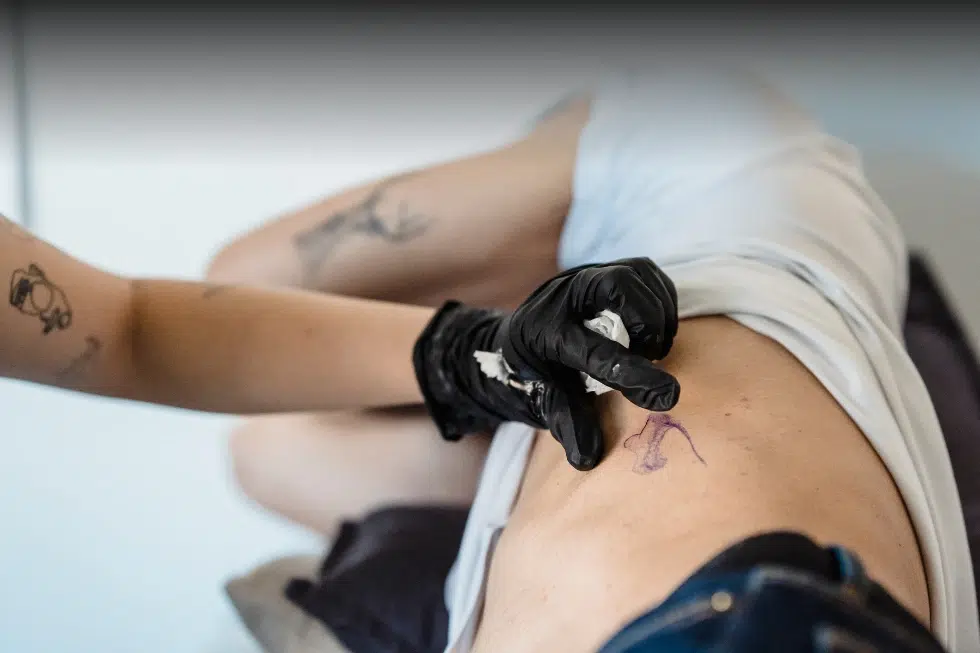
This is the kind of detail that gets sorted out at a consultation when an artist stencils the design directly onto your skin. You can see exactly how it fits the area before a single drop of ink is placed.
The Ageing Factor: How Size and Longevity Go Hand in Hand
Every tattoo ages. That’s not a flaw, it’s just how skin works. But some tattoos age far better than others, and size plays a big role in that.
Here’s what to think about when you’re choosing your size:
- Black and grey vs. colour: Black and grey ink tends to hold its contrast longer than colour. Colour can fade unevenly, especially in Australian conditions with high UV exposure. UV radiation is the leading cause of tattoo fading, and a high-SPF sunscreen applied consistently is the single most effective thing you can do to preserve your tattoo’s clarity after it heals.
- Undersized tattoos age faster: The smaller and more detailed a tattoo is, the faster fine lines compress and blur. A design that needs ten years of longevity in a detailed, fine-line style will need more size than the same design in a bold traditional style.
- Planning for decades: Artists at studios across Melbourne and Adelaide increasingly talk to clients about the 10, 20, 30-year picture. What will this piece look like when your skin has changed? Sizing with that in mind is good advice, not an upsell.
On average, every 3 to 5 years is a good interval for touch-ups on fine line work, though tattoos on hands or ribs may need more frequent attention. Sizing your tattoo appropriately from the start reduces how much maintenance it needs over time.
Working With Your Artist on Size at the Consultation
Here’s where clients sometimes get things wrong: they come in with a specific size in mind and treat it as non-negotiable. That’s not always the best approach.
Your artist has tattooed hundreds, sometimes thousands, of pieces. They know what holds and what doesn’t. When they recommend a size, it’s based on your specific design, your specific placement, and their experience of watching tattoos age.
A few tips for this part of the process:
- Instagram and Pinterest references are a great starting point, not a blueprint. A photo you found online may have been taken fresh, heavily edited, or shot in lighting that makes the tattoo look sharper than it is.
- Bring multiple reference images so your artist can understand the style and feeling you’re after, rather than copying one specific video or photo.
- Let the artist stencil the design onto your skin before committing. This is standard practice, and it’s genuinely the best way to see how the size and placement will sit on your body. You can adjust before any ink touches your skin.
- Ask questions at the consultation, not after the stencil is approved. Once you’ve approved the stencil, the conversation about sizing has happened. Changes after that point can affect the booking and the artist’s session planning.
- Check the artist’s portfolio for healed examples, not just fresh work. A tattoo looks different once it’s settled into the skin, and a good artist will have healed photos to show you.
The consultation is the right time to ask every question, raise every concern, and make sure you and your artist are completely aligned before the appointment begins.
A Quick Tattoo Sizing Reference for Common Placements
This is a starting point for the conversation at your consultation, not a rigid rule. Every design, every body, and every artist is different.
| Placement | Suggested Starting Size | Style Notes |
| Wrist | 4–7 cm | Keep designs simple; avoid heavy horizontal spread |
| Inner forearm | 6–15 cm | Excellent area for fine line, realism, script |
| Outer forearm | 8–20 cm | Versatile, heals well, suits most styles |
| Upper arm | 8–20 cm | Great for bold traditional or large realism |
| Shoulder/cap | 10–20 cm | Works well for round, contained designs |
| Chest | 15–30 cm+ | Suits large-scale, symmetric designs |
| Ribs | 10–25 cm | Pain level is high; discuss sizing carefully |
| Thigh | 15–30 cm+ | Ideal large canvas with good healing conditions |
| Back (upper) | 15–30 cm | Good for medium-to-large bold pieces |
| Back (full) | 30 cm+ | Best suited to experienced collectors |
| Ankle | 3–7 cm | High fade risk; keep designs bold and simple |
| Finger | 1–3 cm | Very high fade risk; minimal detail only |
Ask your artist at Art n Soul to stencil your design onto the area before your appointment is confirmed. That one step removes most of the guesswork.
The Stats That Might Make You Think Twice
The Australian tattoo market was valued at AUD 37.16 million in 2024 and is expected to grow at a CAGR of 11.40% to reach AUD 109.38 million by 2034. More Australians are getting tattooed than ever before, and the market for touch-ups, cover-ups, and removal is growing right alongside it.
One in five Australians with a tattoo say they regret, to some extent, getting a tattoo, and one in four have looked into or commenced tattoo removal.
Of those Aussies with ink, a staggering 34% regret the decision or are considering getting it removed. The demand for tattoo removal services has seen a massive increase of 440% in the past decade.
A significant portion of those regrets is about design choices that could have been handled at the consultation. Getting the sizing right from the start, with the right artist, is the best insurance against becoming one of those statistics.
Ready to Get It Right? Book a Consultation at Art n Soul
If you’re planning a tattoo in Prospect or anywhere across Adelaide, the single best thing you can do before committing to a size is to come in for a consultation at Art n Soul.
Our artists will stencil your design directly onto your skin so you can see exactly how it sits on your body before a single drop of ink is placed. No guessing, no hoping it looks right. You see it, you adjust it if needed, and then you make the final choice with confidence.
Book your consultation here and bring your reference images. Our team will work through the size, placement, and design options with you and help you land on something you’ll still love in 20 years.
Frequently Asked Questions
1. How do I know if my tattoo design is too small for the detail I want?
If your design has fine lines, small text, or portrait detail, your artist will tell you the minimum size needed to hold that detail long-term. Trust that guidance. It saves you from a blurry tattoo in five years.
2. Can I bring a reference photo and ask for the exact same size?
You can use it as a starting point, but photos online are often shot fresh and edited. Your artist will assess the design and placement on your body and give you an honest sizing recommendation.
3. Does a larger tattoo always cost more?
Generally, yes, since larger pieces take more time. For a specific quote, book a consultation so your artist can assess the complexity and give you an accurate estimate.
4. Why do artists sometimes recommend going bigger than I planned?
Usually, it’s about longevity. Certain styles and placements need a minimum size to hold their detail as your skin changes over time. Your artist isn’t upselling; they’re protecting the integrity of the piece.
5. What’s the best placement for a first tattoo?
Somewhere with flat, stable skin and lower pain levels, like the outer forearm or upper arm. These areas heal well and give an artist enough space to work with good detail. Bring your idea to a consultation, and your artist will help you find the perfect fit.